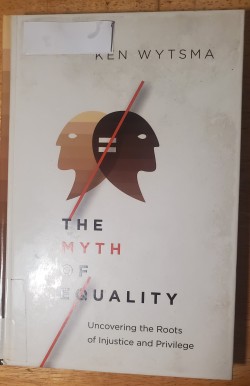
Talk about an eye-opening book! Ken Wytsma has given us one of incredible value here. The Myth of Equality is subtitled Uncovering the Roots of Injustice and Privilege. The “roots” claim is valid. Wytsma’s is an American story, not just of centuries or decades past, but of the present as well.
It is written particularly to Wytsma’s fellow Christians who are theologically conservative. But not them alone by any means. Anyone reading is almost certain to have their eyes opened to specific events and statistics (even if generally well-informed on racism and inequality in America), and to broad patterns of human nature and history that transcend the American scene.
Some of this history and analysis one can read in a good number of books. But what is not likely found elsewhere is the angle of a white pastor and public speaker who has sought out the experiences and perspectives of many black leaders and friends yet admits he cannot ever fully know their experience. Also rare in this context is the social and theological insights of an Evangelical. (One by theological definition, not the implications of right wing politics or Trumpism that “Evangelical” has come to carry since the election of Trump, which the author definitely does not share).
The copyright of the book is 2017, but it appears to have been completed sometime in 2016, possibly before the election of Donald Trump. Trump is not named in the book. But Wytsma addresses many of the issues that came forcefully to the fore in late 2015 through 2016 and the election. Rather than wander into related but diverse issues, his focus remains consistently on those of race and equality. I don’t recall him discussing the distinction between social (or racial) equity and social equality, and “equity” does not appear in the helpful index. Such a discussion is one small addition I’d have welcomed.
The author is, however, a “word guy”. He often traces terms to their roots and original meanings and uses, such as racism and slavery. Interesting stuff. He clearly describes what is and is not “white privilege”. Significantly, he does not deny the existence of instances sometimes called “reverse racism”, but argues the application of that term is generally a gross misuse of the idea of real racism (on which point I agree with him).
I found The Myth of Equality a very readable balance of education (via important history, statistics, analysis, story-telling) and exhortation. He’s calling his fellow Jesus-followers (particularly but not exclusively within Evangelical/charismatic denominations) to follow the Hebrew prophets’ and Jesus’ teachings on love of neighbor. Definitely with the recognition that they, and everyone, must deal with how many among us have been unloved and mistreated, not necessarily by overt racists, but in the outworking of systems of oppression and inequity in place for anything from decades to centuries. Wytsma’s case in relation to Christians is not defects in the Bible’s presentation of what is called “The Gospel”, but in Christians’ failure to pay attention to it and do the hard work of applying it…. Not just settling for having a minority friend (or several) but “emptying” themselves, like Jesus, in humility and service.
Don’t let the relative age of this book dissuade you… it is still “up to date” and very worth reading and seeking to apply.
This is a re-post of a 2013 article which is pertinent for the pre-Easter season particularly, and historically, for non-Christians as well as Christians. The book titled Zealot is probably little known any longer among a younger generation of Jesus-followers and others interested in who Jesus was and what he did. I feel it is still a worthwhile read although many more “historical Jesus” books have appeared since 2013.
Please note that I am neither agreeing nor disagreeing with the conclusions there. Rather, my article is focused on one key incident, the “cleansing of the Temple”. The recounting of it is loaded with religious meaning, but also with historical insights, in my view. The way it is prominent in all four of our NT Gospels is just one reason I believe it is historical (in some version elusive to us) though it hints at things the Gospel writers sought to keep obscure. At the same time, they wanted or felt compelled to reveal what led to Jesus’ fatal clash with the “kingdoms of this world”.
The original article:
The publicity around Reza Aslan’s recent book on Jesus: Zealot: The Life and Times of Jesus of Nazareth has shown that both scholars and lay people are far from settled, 2000 years later, on just who Jesus was. What was his main identity and mission?

Corcovado jesus (Photo credit: @Doug88888)
Aslan’s point of Jesus having been a nationalist zealot (though not member of the “Zealot” party dedicated to violent revolution) is not a new one, by any means. A certain “line” of New Testament and Christian Origins scholars has been contending this for a very long time, with increasing detail and support as the surrounding scholarly fields have matured and further archaeological discoveries been made.
I won’t take space today to review the points of this scholarship… an extensive project. I merely want to tweak your curiosity and point out something I think should be of much greater interest than it seems to have been up to now. As my title suggests, there is something almost hidden in what most Christians have read (or heard read/preached), probably repeatedly, in the Gospel stories of Jesus’ crucifixion. It at the least puts Jesus right in the context of a Jewish insurrection against Rome…. not necessarily that he was involved in it or sanctioned it. But there are a number of curious things in the texts that are hard to put together.
Now, I don’t mean the major rebellion 30-some years later that became a horrendous war of 4 years and ended in the destruction of Jerusalem and the Temple in 70 CE. That one is of particular importance to the New Testament (NT) and the origins of Christianity; and the NT is curiously vague and seemingly evasive about it. (That is, based on the consensus dating of the Gospels and Acts as written after the war, or even just Acts if not the Gospels… Acts written after Luke by the common author’s own claim. Even if the Gospels/Acts are pre-70 in present form, they avoid almost all direct discussion of the contentious political and economic situation.)
Back to the pre-crucifixion narrative, did you notice the insurrection mentioned just in passing? (And largely hidden by unfortunate translations in most popular versions until recent decades, especially the King James Version?)
This insurrection appears at least indirectly in all the Gospels. We encounter three rebels from this uprising… two as the “thieves” (a Greek term often now translated “bandits” and connoting guerrilla fighters or insurrectionists) crucified on each side of Jesus. But also, the prisoner released rather than Jesus, upon the offer of Pilate, named Barabbas, is clearly an insurrectionist – a “notable” or “notorious” prisoner (KJV, NIV, Matt. 27:16). He is also said to have “committed murder in the uprising” (Mk. 15:7, NIV; KJV has “insurrection”). The picture is building of something more than the raging of a madman.
Mark 15 has it that Barabbas was in prison with “the insurrectionists who had committed murder in the uprising” (the Greek text makes it clear that insurrectionists [plural] had committed murder, not Barabbas alone). So we have at least 3 rebels and more than one of them has committed murder…. Based on other NT accounts as well as those of the historian, Josephus, it is likely that the number of rebels would have been substantial. The way the story goes throughout the four Gospels, the implication is of an insurrection of some note. For example, in Mark we have the wording quoted above, as if readers would know what “the insurrection” was. More in flow with the story would be “an uprising” (it not yet having been referred to). But we read “the uprising”. It is possible Mark indirectly had told us of “the” insurrection?
The only thing in the preceding story by Mark that might be considered an uprising of sorts is the “cleansing of the Temple” incident by Jesus. The real situation (assuming, at least for the moment, that the basic incident as well as the others described did happen) remains murky in comparing the Gospels. But Mark (ch. 11) has it that upon upsetting the tables of the money-changers, “driving out those who were buying and selling there”, Jesus “would not allow anyone to carry merchandise through the temple courts” (a very large area, clearly implying the help of at least his immediate disciples or others).
It doesn’t say for how long he shut down this commerce vital to Temple operations but the incident was, in the story, just days before the crucifixion. (John, interestingly, has the same basic story set at the beginning of a multiple-year ministry of Jesus, and nothing comparable at the end.)
At any rate, whether or not Mark intended to connect “the insurrection” with the “cleansing” incident, neither he nor the other Gospel writers saw fit to (otherwise?) describe the rebellion in which at least three fighters were captured. And there had been multiple deaths… not a mere “peaceful protest” or a small scuffle! I do think it is safe to assume it was very close to the time of the crucifixion. That is because we know that the Roman soldiers crucified many, many rebels and seemed to do so with little if any formal trial and swiftly upon being captured…. The whole point was for the public torture and disgrace to be a strong deterrent to other potential rebels… counterproductive to keep prisoners for long if they are destined for execution.

Jesus, on the cross, is mocked in Calvary as the King of the Jews, Luke 23:36-37 (Photo credit: Wikipedia)
So why do the Gospel writers all include the fact of an insurrection, probably near the time of the crucifixion and in or near the geographically small city of Jerusalem which swelled to nearly a million in temporary population around Passover? Why do so, yet basically downplay its seeming significance? A number of answers are possible but I won’t here go into exploring that.
But isn’t it at least interesting that Jesus, while his message does seem to have been non-violence consistently, used some kinds of force in the “cleansing” incident, though perhaps not causing injury? (Or was it a major violent event, purposely toned down in the Gospels?) And further interesting that Jesus was crucified in the context of insurrection? It was among what may have been fairly regular, mostly small uprisings against the Romans and/or the ruling Jewish elite who collaborated with them. (The late 1st-century Jewish historian for Rome, Josephus, wrote a lot about such uprisings and the general turmoil of the times.) Throughout the rest of the Gospels, we get hardly a hint of the tense situation throughout Galilee and Judea, including Jerusalem, during the time of Jesus’ ministry. Everything appears to be pretty settled, calm and “normal”…. But was it?
And could Jesus’ action in the Temple courts have been either intended or taken as a serious challenge to the ruling authorities rather than just religious symbolism?
What do you think, and what does “the insurrection” and the context bring to mind for you?
Review of “The Kingdom, The Power and The Glory”
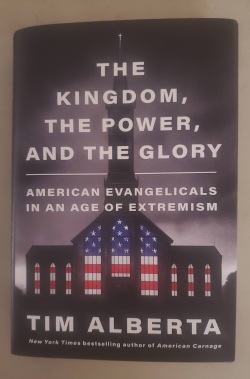
I found Tim Alberta’s recent book (Dec., 2023) engaging and very well written, and thus easy to read. The full title describes it well: The Kingdom, The Power, and The Glory: American Evangelicals in an Age of Extremism. It IS long, so it takes a while. But there is no irrelevant froth in it, unless one doesn’t appreciate the significant personal aspect which is a strong element in the book. I found that to make the book both more interesting and more credible.
You see, Alberta is a life-long Evangelical (also white, like the big majority, perhaps all, of the Evangelicals he interviewed, attended events by, and researched). One light criticism is that some might wish for him to have included a little more on the distinctions among Evangelicals which are closely tied to skin color or marginalized status. (Marginalized in primarily economic, educational and other ways different than the perceived cultural or political marginalization that often drives white Evangelicals politically or in “culture wars”).
His focus was basically confined to predominantly white Evangelical churches and leaders, which is a legitimate focus. However, especially since “white” is not in the title or subtitle, it might have been helpful to have a little more “compare and contrast” with non-white Evangelicals, especially the often-influential Black churches and denominations theologically similar to the rest of Evangelicalism. Perhaps a justification for his not speaking much about such Christians is his conclusion that, for most Americans, “Evangelicalism” has been redefined from a theological/evangelizing focus to a primarily cultural/political one in the eyes of most Americans. Indeed, Alberta opines that Evangelicals themselves are mostly responsible for this precisely because of their drive for political Power, to force [my term] the Kingdom and its attendant Glory. (For those not familiar, the book title citing kingdom, power and glory, comes directly from the ending of the longer version of “the Lord’s Prayer” from the Gospel of Matthew, considered a universal prayer for Christians worldwide.
I’m especially impressed with this book because it is a masterful blend of story-telling and research, both substantive and entertaining. Story-telling as to his personal life experiences and how they bear closely on his pre-interview research presented in story fashion. And story-telling as to historical antecedents to the current Evangelical situation and his many in-depth conversations with leaders, enhanced by attendance at gatherings (like church services) and events, large and small.
Chapters are headed by locations – cities and states (twelve states, plus DC and France). It is also generally chronological, from 2019 to 2023 as to his on-scene research. However, there is some necessary circling back to earlier interviews, as the author returned on subsequent visits. I found it only mildly challenging to keep things straight in this regard. The fact that Alberta spent about 4 years in the research aspect is impressive in itself. Only a well-funded, already accomplished journalist and author could get the backing for this kind of extended work, with the necessary copious amount of travel.
It may be of some importance that Alberta’s own roots are in a very Evangelical part of Michigan. From reporting there, he ranges to the East Coast, the South and a little into the Sun Belt and West Coast. If any regions were under-represented they might be the deep South, the Mountain West and the West Coast. But he deals extensively with the Southern Baptist Convention and its history of changes, scandal, and turmoil up to the present. The deep South is additionally represented fairly well by his detailed history of, and interviewing at Liberty University in the Mason-Dixon Line state of Virginia, probably the most influential (and largest) single Evangelical University in America. The Mountain West and West Coast were further for him to travel, and perhaps not quite as heavily into the extremes of Evangelical MAGA and Trump support, as to their lower representation. There are indeed many, many small to very large churches of Evangelical affiliation, if not always as political perhaps, in this region (where I’ve lived all my life – California and Oregon – attending or occasionally ministering in Evangelical churches until 1995).
The Kingdom, The Power, and The Glory deals heavily with the lust for and the seduction of power, from the congregant in the pew to the pastor in the pulpit. Then there is the additional, highly influential level of power broker in terms of organizing, promoting and rallying the “troops” (as in culture wars) via large, well-funded organizations. Some of these, plus many smaller players that Alberta recounts, have sold rafts of MAGA and related items at the many rallies he covered. So there is the profit motive at work in some elements of the evolution of Evangelicalism he documents, again, from a close-up angle.
I would not be surprised if this book becomes a required text of sorts (or “collateral reading”) in college and grad school courses on things like the history of American Christianity, politics and religion, public theology, etc. But what’s nice is that it reads nothing like the typical textbooks most of us are familiar with. If you have an interest in the current political dynamics at work in the 2024 elections, particularly for President but also “down ballot”, this is a must read. If your interest is more broadly about what’s happened to Evangelical churches in America, and many of their members, whether MAGA supporters or not, I think you’ll be enthralled by what Alberta covers… and likely disgusted in learning more than you’d perhaps wanted to know about several widespread scandals. They are not all political in the sense of civil government but they involve internal church politics heavily.
What may be of value particularly to Christian readers is the way Alberta, mostly via the main leaders he reviews but also church members and himself, wrestles with the issues of personal faith, and with the incredible strain and rupture of relationships happening around the polarization and animosity none (even the oldest) of us has seen in our lifetimes.
Whatever Happened to Big Tent Christianity?
I just noted we are at the thirteenth anniversary of the second Big Tent Christianity conference. Sadly, it proved to be the last (so far, anyway). The first had convened in September, 2010, in Raleigh, North Carolina. I attended only its follow-up, second conference in Phoenix, AZ, in February, 2011. I don’t recall knowing of the size or level of enthusiasm of the first conference, but I’m presuming from the little I heard, that it was similar to the second.
The attendance in Phoenix the following February (an enticing month for much of the country to get to Phoenix) was around 300. My sense was that, aside from the main speakers, the attendees were primarily from the West, particularly Arizona and California (my state at the time, and since). Regardless, the reason for most, in not all, to be there seemed to have little to do with weather or merely “getting away”.
Folks were there with genuine interest, even excitement, to experience a coming together across many denominational and theological/social lines. And the fact that 300, mostly clergy and church staff, plus a variety of writers and church-related ministry directors including the late Rachel Held Evans and Marcus Borg, along with Brian McLaren, Richard Rohr, and other notables, found their way together seems a great feat in relation to the atmosphere that has developed since 2011. That tense, divisive atmosphere certainly intensified since the candidacy and presidency of Donald Trump, dividing many churches and leading to many estrangements among professing Christians and others.
I do not fully know “whatever happened to” this “big tent” endeavor (as aside from long-term and ongoing formal ecumenical gatherings, such as the continuation of one formally called “Act 3”, now under the name The Initiative, founded by John Armstrong). To my knowledge it was unique in style as an effort to get Christians together from widely diverging traditions and belief systems. I do know that the hard work of planning and organizing such events had to be abandoned by Philip Clayton and perhaps other key helpers, due to his other obligations. But the sense of excitement to continue such convenings seemed to be strong as the 2011 Big Tent Christianity “folded up”. (It was not held in a tent, but a very nice church facility.)
It seemed there was a lot of interest to continue what had been a rich and growth-inducing time… a rare “ecumenical” and practically-oriented gathering focused more on living out Christian faith, from many angles, than on trying “merely” to better understand and accept one another. Certainly, the latter was a part as well.
My cursory observation at the event was that traditional “Evangelical” leaders and lay people, by a pre-Trump-era-definition involving theology more than political commitments, were there in fewer numbers than were Mainline clergy and laity. But a significant set of theological, church structure, and worship style differences were commented on, with a sense of real appreciation for this kind of event purposely drawing fairly broadly from a Christian “tent” conceived to be expansive.
Will such events be convened again, anytime soon?
I haven’t heard any such stirrings, but I could certainly be “out of the loop”. I would think that such a thing may be greatly longed for by many, as a sort of pendulum swing back from so much of the Evangelical tradition, along with a good percentage of Catholics, being strident Trump and MAGA supporters. Their positions and attitudes have been alienating to most of those with differing loyalties, and even those who have been ambivalent, if not divergent politically and thus not joined with them. I recognize that many of the Christians among Trump’s committed base are there precisely because they have felt misunderstood and disrespected (and thus threatened/fearful), and sometimes with good reason.
Hopefully the grace emphasized across the Christian theological spectrum will lead to effective reaching out and open responsiveness…. perhaps after the election! And similar powerful, practical events like Big Tent Christianity will be sponsored and built upon!
Review of “The Gospel of Thomas and Jesus”
Perhaps the most significant discovery of ancient religious texts of the New Testament era (1st and early 2nd centuries) was the one which included the Gospel of Thomas. It was made in late 1945, in southern Egypt, near a place called Nag Hammadi (the name generally attached to the collection of key texts discovered there).
Among the important and fascinating texts found, the one given the title Gospel of Thomas has created the most stir, continuing to this day, although at a lowered level of intensity than the period of the late 50s to the 70s. (It wasn’t published, even for most scholars, until 1958 though discovered in 1945, for complicated reasons not much related to the good condition of the text itself.)
So why was this text the most lauded one? Why has it provoked not only intense scrutiny and comparative study but also deep controversy? Is it a text that perhaps should have been included in the canon of the New Testament gradually developed well after its composition?
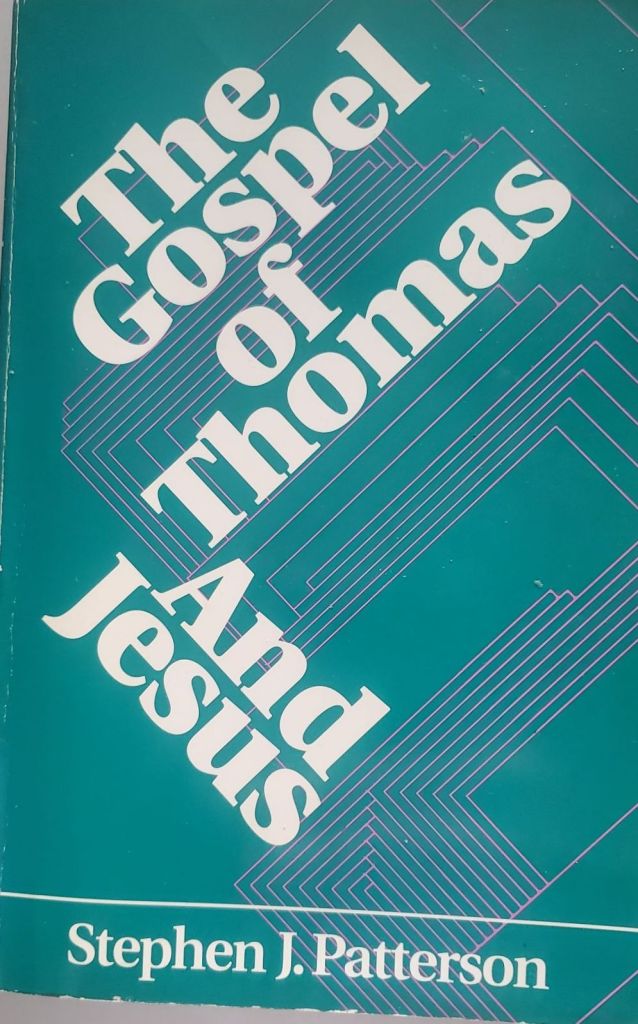
You can get substantive answers to these and many other fascinating questions in this book by accomplished New Testament scholar, Stephen J. Patterson. (It was one of his earlier works, completed in 1993.) If one is fairly new to the Nag Hammadi texts more broadly and to the Gospel of Thomas specifically, I’d recommend gaining a little familiarity via a good and largely “neutral” or balanced source such as Wikipedia. There are fringe and unhelpful views existing which can distort the careful and responsible scholarship of people like Patterson.
You may wonder why I’m reviewing a book this old, especially if you are aware of how much views on many biblical and Bible-era issues change, sometimes quite rapidly. Among the reasons, a key one is that I was already familiar with Patterson’s work, respected it, and wondered what his contributions might be to my interest in better understanding the Gospel of Thomas. I have been particularly interested in what it may tell us about very early Jesus-following and the teaching of Jesus himself. (This gospel is more purely a collection of purported sayings of Jesus than any other existing text, with many of the sayings closely paralleling ones in our New Testament.) Another reason is that although further detailed analyses have continued since 1993, by this time the study of the text and related texts (some of which only emerged in 1945 from their common burial place) was fairly mature.
Here are a few “take-aways” I consider important from Patterson’s book, which I highly recommend for anyone with more than passing interest in historical Jesus issues, the development of early Christianity and the New Testament (the Gospels in particular):
- Analyzing this “sayings gospel” on any level is complicated and controversial, yet progress toward better understanding of its development, meaning and relation to New Testament texts and others of the same general period progressed a lot in the 30+ years between its modern publication and Patterson’s book. (Much study and scholarly discussion continues to this day, although this is far less in the public eye than it was decades ago.)
- Like other books of its era, the contents of Thomas are better understood if we can grasp something of its context in terms of relationship to other texts, perhaps borrowed from or having an influence on. Similarly, grasping something about its likely audience (socially and in time and geography). There is too much in this regard to even summarize here. But Patterson leans toward a relatively earlier composition than many scholars do, generally in the New Testament era, contemporaneous with the four NT Gospels; and not to Thomas’ reliance on the canonical gospels, though perhaps on sources in common with them.
- Geographically, he favors an origin and audience mainly to the east of Israel proper (Ancient Syrian region, which currently includes Jordan), where many Jews lived and where Thomas has been shown to have traveled and taught. He believes a version earlier than the Nag Hammadi one may have originated in Jerusalem, but the existing one, in Syria. (Virtually all texts of the era went through two or more revisions before becoming codified, less amenable to changes, after a few decades or more with sufficient copying and spreading.)
- Probably the most significant “insight” Patterson develops from the Gospel of Thomas is that it gives us a glimpse into the kind of “itinerant radicalism” described in the Gospels as being launched by Jesus directly. (E.g., his sending out the “seventy” to quickly cover the regions of Judea and Galilee.) That had apparently died down significantly by the writing of the NT Gospels and Thomas, and there were tensions, as one might imagine, between those Jesus-followers still in this mode of evangelization/lifestyle and those remaining tied to homes, families, farms, etc. In the same regard, both the NT Gospels and Thomas repeatedly show evidence of competition among not only Jesus’ original disciples, pre-crucifixion, but also among later followers who often coalesced around the competing “authority” of one disciple/apostle or another.
The important thing for everyone, Christian or not, to realize about this final point is that The Acts of The Apostles, in our New Testament following right after the Gospels, presents a highly selective and slanted picture of the nature of the “early church”. Yet even Acts presents the Jerusalem-based Jesus-followers as remaining tied to Temple worship and retaining, despite periodic persecution, a position as a tolerated Jewish sect which had NOT split off from Judaism more broadly. They struggled with their relationship with Gentile believers in ways quite different from Paul, who had serious disagreements and tensions with Peter, James, and the Jerusalem believers.
Trump and Cult-Induced Blindness

I was hoping to not feel compelled to write another post on Donald Trump, years after my last one. But I cannot remain silent.
I doubt that I have any new concepts of substance to add to the many, many reports, articles, videos, and entire books analyzing him and the phenomena of his supporters.
However, in the hopes that even one person may benefit from something I say here, I will speak up. And I feel I must add my small part…. The threat on many levels is extreme if things don’t change. I fear it’s even possible we could get what some Trump loyalists are saying they see coming in certain scenarios, such as conviction(s) of Trump on felony charges. That is, “civil war”, words said seemingly as literal, not just figurative. And some have been preparing.
Threats include our being plunged into a highly autocratic form of government quite unlike the democracy, imperfect though it is, that we’ve had for nearly 250 years. If more people who have been Trump’s followers, or merely indifferent to what he is and has come to represent in America, do not soon begin to see, even they may soon be shocked and wake up only after it’s too late!
Right now, the American public could turn things around dramatically. We don’t necessarily have to wait for one or more convictions from Trump’s many felony counts, or merely hope that he will not win the Republican primary or the general election in 2024. But I have to admit we may well have to.
Too many Republicans (plus a few others) are in his thrall. Estimates are in the 30% to 35% range among all voters who promise to stick by him no matter what is yet revealed that they may not have known; even if he becomes a convicted felon who nearly succeeded in forcefully overturning a presidential election. That is, per the latest indictment, if he’s found guilty on charges of conspiring to defraud Americans of their rights (particularly to have their votes count) or of obstructing the peaceful transfer of power to Biden.
To “turn things around” before a potential conviction or election loss might provoke the turn, the thralldom would have to be broken. That seems unlikely at the moment, sadly! There are at least two distinct realms in which people are under Trump’s spell.
- First, the much larger and foundational group: voters.
- They lead to the second, much smaller but much more influential group, person for person: elected officials from local and state to national levels.
I’ve tried and tried to understand the mentality of millions of Trump’s hard core supporters…. succeeded only partially. That despite having a conservative orientation in teen and young adult years, plus decades of relevant education, (formal degrees plus much self-guided study). Yet I cannot fully grasp the dynamics involved, particularly with the first group, voters. And particularly puzzling is the sub-group (also in the millions) of Evangelical Christians, of which I was one from childhood to about age 45.
I was raised in an Evangelical family and church, educated in that framework through bachelor’s and two master’s degrees (MDiv and MA in Marriage and family counseling – the three, 1967 to 1978). Additionally, I worked for four years during seminary and after in “Christian defenses” with special attention to understanding and combatting Christian-related “cults”. (“Cult” is a broad and often loosely applied term, but here is the basic meaning for “cult-induced” in my title: the exceptionally loyal group following of an authoritarian figure to the extent of loss of critical thinking about the leader’s and group’s beliefs and/or actions.) Strong social reinforcement and “us vs. them” mentality makes it additionally tough to remove oneself from such a cult.
I have been reticent to put the bulk of Trump followers in any category called “cult” or “cult-like”. Now, finally landing there, I am far from the first to suggest it. Others more expert by far than I, in following and grasping the political scene, have been saying this for some time. The context for my knowledge of cults has been mainly religion. What I’m realizing is that Trump cultism is much like religious cultism.
Now, softening the pessimism as to cult members “leaving” the group or disavowing their leader, is this: It is happening, perhaps more than seems so outwardly. That may be partly because Trump followers are generally involved in the broader culture and have friends or family members who are not supportive of him. Through them and media sources, they at least occasionally hear news they cannot relegate to “fake”, particularly major developments such as indictments of Trump, or the extremes of his vitriol and lies in response. As to media, they may only see news through a deeply tinted lens of certain cable channels or social media friend or interest groups they’ve chosen. But they do hear some basic facts that often challenge their undue loyalty. And their critical faculties are not entirely dormant, though highly resistant to re-examination. So I am not despairing.
However, even if we do see a significant breaking away from blind support of Trump, I will have seen things I can’t “unsee”. They will still cause me and many others deep concern about the stability of our democracy. They indicate that spiritual commitment (especially within systems emphasizing purity and adherence to orthodox dogmas) can easily lead to loss of discernment… to a deficit of sight perhaps worse than blindness: an active distortion of provable, easily discovered facts, along with a conscious refusal to allow one’s perceptions (not just opinions) to be adjusted by listening openly to others.
It may go without saying that if group one above, voters, start looking deeper and adjusting unrealistic hopes, their new views would show up in polling. This would then free the spineless politicians who actually don’t like or want Trump but won’t say so or strongly counter him, to begin breaking away. If enough of them do so, there will likely be a snowball effect and the Republican Party itself might be able to be salvaged (which remains very questionable at this moment).
Conversely, Republican so-called leaders, could actually begin to lead by speaking truth, taking the risk of losing their next election as a result. We’ve seen this from Liz Cheney and Adam Kinzinger, and a very few others. But there don’t seem to be others willing to so lead… thus far. I suppose it could yet change, but I don’t see the signs. If a good number of Republican politicians did step up as leaders, they might be able to start opening the eyes of the blinded folks who put them in power.
Whatever happens, we will have a great, great need for restoration of trust, of civility, as well as compromise and collaboration. We can do it, and a determined movement toward the principles of a truly “deliberative democracy” should be part of the healing and growth process.
A Call to Provost, Dr. Hall, at Biola University

Below is a letter I sent to Dr. Matthew J. Hall, the new provost and senior vice president at Biola University. I attended Biola for three degrees in the late 1960s to late 1970s. This is a response to remarks of his at his installation earlier this year. Beyond my points here, I have numerous theological departures from my days at Biola, but wanted to keep a primary focus and limit the length of the letter. I also here use more Christian lingo than I typically use, and in ways Dr. Hall would probably mean a little differently than I do.
The letter, after minor edits:
Dear Dr. Hall,
I just read the adaptation of your installation address in the Biola Magazine. Interesting to read!
I’m a triple alum – Biola, Talbot, Biola, MA-MFCC (1967-1978). I’ve been “all around” in the Christian world, and fond of higher education, so recognize the wisdom of your approach on many points.
I’m now involved in transpartisan efforts for deep electoral reform and some additional structures to enable a truly “deliberative democracy” which will allow God’s Spirit to be expressed through much broader and more conviction-led representation than we now have.
Even with the diminished percentage of self-labeled Christians in the US (now about 63%, “devoted” ones much fewer of course), lowered church attendance, etc., Christian influence both culturally and politically is still very strong. It could be stronger if democracy is more pervasive. “Kingdom” influence, that of Jesus, will be far weaker if autocratic trends continue and prevail.
Sadly, although I push for transpartisan means and ends, I must thoughtfully charge the Republican Party with fanning the far more serious threat in this regard than does the Democratic Party. And that will likely continue, even if Trump ends up convicted, imprisoned and out of his currently still “controlling” position in the party.
So I appreciate your subtle critique, “… both the political right and left seem to be gripped with their own fevers du jour.” I’d liken the “right’s” fever to an autoimmune reaction of runaway inflammation which would not purge the virus, but kill the host.
Key point of evidence is the 81% (or so) of white Evangelical votes for Trump in 2016. The excess over the close-to-even Catholic split (around 50/50 I believe) and the edge (over 2 million) for Clinton in the nationwide vote probably tipped the presidency to Trump in the electoral college.
One could argue that many or most Evangelicals didn’t yet know Trump for what he is was/is, particularly in his faux religion and his outward disagreement with Jesus on forgiveness, honesty, mutual respect and grace, etc., etc. However, I’m sure they DID know about his sexual immorality, his cruelty, and general bad character.
But then, in 2020, Evangelicals voted very nearly as strongly for Trump as in 2016, despite the numerous, continual revelations of the things touched on above and much more, such as administrative incompetence and support for cruel and godless dictators.
NOW… to the present, the Evangelical loyalty to Trump still is largely unshaken, in the aftermath of his clear defying of the will of God (as expressed via our electoral and judicial systems, based on “rule of law” – powers “ordained by God” … cf. Romans, etc., as you are aware).
There are a number of reasons why, as you say, “…historic Christian orthodoxy is less welcome in our public square than it was a decade ago.” Some of them lie squarely on “orthodox” Christians themselves. (I remain identified as Christian myself, but admittedly no longer orthodox by most definitions.) Some of them relate to what I’ve just covered; some to the matter of posture toward various gender and sexuality issues you also briefly refer to. In that, my point is not to “side” with secular culture (or “modern paganism”) but to note that the over-reaction by many Christians as seen in “purity culture” programs for youth, does go to an opposite (and counterproductive) extreme. That turns off many sensible people who may not join in with “modern paganism”.
My personal plea to you would be to become assertive, in your role with Biola, in helping students, staff and constituency to be far less politically partisan. Rather, be more committed to the clear guidance and example of Jesus toward Kingdom ethics – the creation of conditions as well as personal behavior that cares for “the least of these”. Charity and the “private sector” alone cannot accomplish this in a society like ours… it takes that plus good civil governance.
Review of “Losing My Religion: How I Lost My Faith Reporting on Religion in America — and Found Unexpected Peace”

This book somehow escaped my radar until recently. I’m glad I ran across it!
Here is a vulnerable, frank story of a journey to Christian faith and back out – by a kind of professional seldom heard from as to their faith journey – a reporter.
I must add that author, William Lobdell, was not merely a “beat” reporter, but at times also a newspaper editor. He did some complex and deep investigative reporting. If one lived in the Los Angeles area during his era with Los Angeles Times affiliated papers, and followed issues and stories on religion, one would know his name. (I did not, having lived there before his time. I knew of or was involved with some of the churches and organizations important in his personal life and reporting, however. So the book was extra meaningful to me in that regard, but it is far from merely regional in the significance of his reporting and, of course, his own journey.)
Lobdell plunged into the kind of “life of faith” I had been raised within from birth and endeavored to live from my teen years to my mid-forties. His “born again” experience came at age 28. He studied voraciously about his new faith, eagerly participating, even as he advanced rapidly in his main interest area in reporting – religion.
An interesting side issue in the book is Lobdell’s success in transforming, for at least a while and particularly in the vast Los Angeles area, the way religion is covered and dealt with in newspapers. (I happen to feel as he did, that the issues, events and people in religion, are generally not given the attention or quality of reporting and analysis they deserve… I say as a fairly faithful church-goer more concerned with the community, ethical and spiritual/emotional aspects of religion than the “worship”, dogma or institutions.)
Though the book is about 14 years in circulation, its issues are fully contemporary – both the kinds of scandals and tragedies Lobdell unearthed and the wrestling with issues of faith and affiliation with others, whatever the church. It reads very similarly to many of the posts one can see continually online, within a number of Facebook groups, personal blogs, etc.: how to reconcile the many contradictions between ideals and stated beliefs and actual behavior by “believers” as just one aspect; whether the theological tenets make coherent sense in any kind of logic, for another.
In the case of the author’s career in newspaper investigative reporting, much of this was in the very early days of the breaking-open of the severe, saddening numerous cases of sexual abuse of minors by priests and their cover-up by church officials in location after location. Lobdell, after conversion and deep immersion in an Evangelical Protestant setting, had studied and worshipped with Catholics a good period and very nearly took membership there.
The drama of that situation, in the midst of his heart-rending discoveries, alone is worth the reading of this well-written, deeply thoughtful book. (Protestant scandals were among the things he also investigated and reported on, lest he, or my review, appears to be picking on Catholics to the exclusion of other denominations.)
If a potential reader has been sexually abused or experienced trauma in a church setting, I do advise caution in reading this book. If you are emotionally stable and open about critiques of what you may believe religiously, or are otherwise interested to hear some of the darker “inside stories” of religion and its American institutions, steel yourself and jump into this book!

What happens when Southern white Evangelicals leave their churches? Do they become more politically progressive? Less literalist about the Bible? More inclined to the “common good” than their church-going friends?
According to a new study, apparently not. It has some interesting, important findings.
The article is by Daniel K. Williams, published by Christianity Today, here (thus not biased against Christians or churches).
Back to the opening questions: Williams’ analysis of extensive data finds that a significant percentage of white Evangelicals in the South rarely if ever attend church anymore. But they tend to remain Republican. They don’t become more progressive except on marijuana use and premarital sex (but remain anti-abortion).
They continue to view the Bible as the inspired Word of God, if not to be taken literally as well.
Their individualism seems to be accentuated relative to their churched counterparts (whether as cause or effect of leaving is not discussed). With this is a suspicion or distrust of virtually all institutions. However, trust in the military remains high. As one would expect, the media is on the distrust list.
I recommend you read the article for its deeper analysis and specifics of data. But from my very brief overview here, what might we glean as helpful information? For one thing, the effort to stay in and contribute to the kind of community that most churches represent is good for both the individual and society. That’s not to say that churches are necessarily the strongest or best type of community. (And the sticky issue of beliefs and their effects is a vital but separate concern for my purpose here.) Many clearly are not great communities, but rather are toxic. They are thus often guilty of inflicting trauma and scattering the flock, even when members have not made a change of beliefs. (The latter is my addition… Williams does not discuss church toxicity.)
Corollary to the benefits of being part of a community is that it appears many “leavers” either are uninterested in finding another type of formalized community or perhaps find it difficult to do so.
Something short of community life that can still contribute to growth and positive social interaction is participation in one form or another of structured, “safe” dialog about polarized issues of culture or public policy. One growing organization which organizes and runs such dialogs-across-difference across the country is Braver Angels, one of some 400 groups affiliated with the Listen First Coalition doing such work.
I also participate in an endeavor to bring further collaboration among these kinds of projects and advance the cause of broad-based, serious deliberation to empower more effective democracy in America, https://CompassionateCitizens.us.
The politics of Paul and the way of Jesus, part 1 [Peaceable Romans #6]
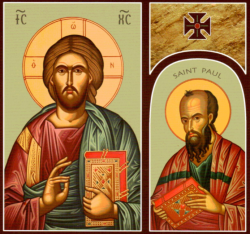
The explanations of the common principles and guidance of Jesus and the Apostle Paul in this recent post by Ted Grimsrud are very insightful and important. They are useful and valuable anytime, but especially so now, in a time when people are so divided and acrimonious in our country. Christians seem as much so as everyone else, failing to apply particularly nonviolence and love of enemies, as both Jesus and Paul taught, in different ways.
If you are not Christian–of another religion or none–I urge you, also, to read this article. It is applicable to anyone… not requiring belief in specifically Christian doctrines of any controversy.
In Ted’s typical manner, he goes deeper (and sometimes a different direction) than what is typically heard in sermons or Christian books dealing with Paul’s teachings on issues like submission to government or to one another in social structures. I think you may be surprised with some of his conclusions, as well as encouraged!

Ted Grimsrud—February 18, 2022
Christians have tended to hold Jesus and Paul in tension. On the one side, Christians of a more liberal persuasion have tended to take their cues from Jesus and see Paul as a supporter of the status quo. Others wouldn’t so much say there is a tension as assume (often without realizing it) that Jesus is not particularly relevant for their social ethics. His message is often seen to focus on personal ethics and the ideals of our future in heaven. For such conservatives, Paul teaches us more relevant political principles, especially about obeying the governing authorities and respecting the state’s police function.
Reasons not to dismiss Paul’s politics
Now, I definitely am on the Jesus-as-central side. Some years ago, I read a wide variety of Christian thinkers who reject pacifism. I was struck with how every single one of them—from evangelicals to Catholics to…
View original post 3,223 more words
 Natural Spirituality - Loving Forum for Spiritual Harmony & Growth